
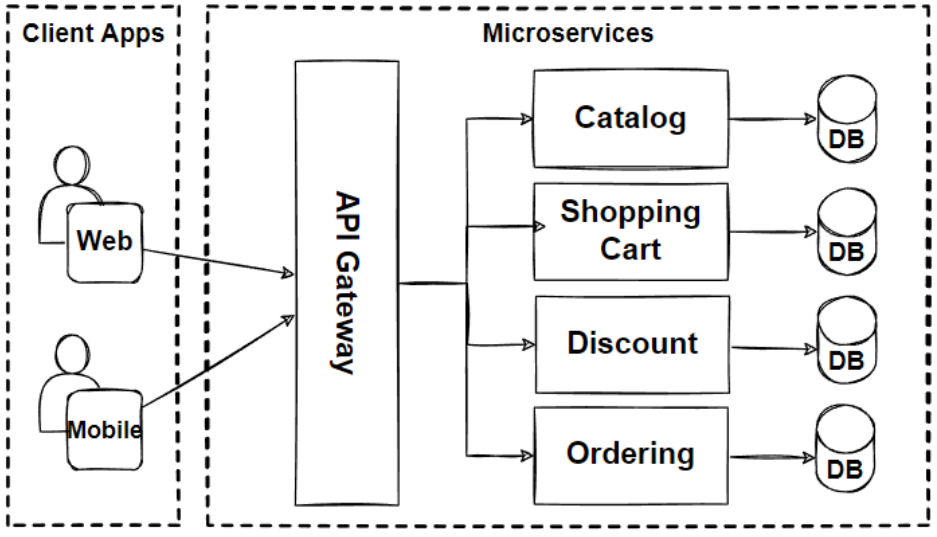
After exploring pessimistic locking—the strategy of acquiring locks proactively to prevent concurrent conflicts and ensure data integrity—this article will shift focus to communication architectures in microservice environments.
Where pessimistic locking addresses how data consistency is maintained within a database transaction, this new piece addresses how services communicate across boundaries: synchronously, asynchronously, or via event-driven and hybrid models. Together, these strategies form part of a full-stack approach to building resilient, scalable distributed systems.
This article explores the key communication strategies in microservice environments: synchronous, asynchronous, event-driven, and hybrid models — along with real-world examples, diagrams, and best practices.
In a microservice architecture, individual services are loosely coupled, independently deployable, and highly scalable. But behind the scenes, these benefits rely on a solid communication design — how services talk to each other.
Table of Contents
Synchronous Communication
Synchronous communication is the most straightforward approach: Service A calls Service B, waits for a response, and then continues. It’s easy to reason about and works well in user-facing flows that demand instant feedback.
This pattern is common in early-stage microservice migrations, where teams break a monolith into smaller services but still rely on direct APIs for communication.
Common Protocols & Frameworks
- HTTP/REST (Spring Boot, Express.js, ASP.NET Core, Laravel)
- gRPC (Google’s gRPC, with support in Go, Java, .NET, Node.js, Python)
- GraphQL (Apollo, Hasura, Hot Chocolate)
- SOAP (still used in finance and legacy enterprise systems)
- Thrift (Apache Thrift for polyglot service communication)
Pros
- Immediate feedback, suitable for customer-facing APIs.
- Strong ecosystem and tool support (Swagger/OpenAPI, Postman, Insomnia).
- Easier debugging with tools like Fiddler, Wireshark, and cURL.
Cons
- Cascading failures: if Service B is down, Service A also fails.
- Harder to scale under heavy loads (rate-limiting required).
- Increased latency when services chain multiple requests.
Diagram
Service A ──▶ Service B ──▶ Service C
   ▲                           ▼
   └────── response ◀──────────┘
Use Case Example
A travel booking platform:
- The frontend calls a BFF (Backend for Frontend) that aggregates data from multiple microservices.
- The checkout service makes synchronous calls to the pricing service to fetch real-time hotel rates.
Asynchronous Communication
In asynchronous communication, services exchange data via messages or events without waiting for immediate responses. This pattern decouples producers from consumers, enabling scalability, resilience, and better fault tolerance.
It’s the backbone of high-throughput systems such as e-commerce platforms, IoT backends, and fintech apps.
Common Technologies
- Message brokers: RabbitMQ, ActiveMQ, IBM MQ, NATS
- Event streams: Apache Kafka, Redpanda, Pulsar
- Cloud-native queues: AWS SQS/SNS, Azure Service Bus, Google Pub/Sub
- Lightweight brokers: Mosquitto (MQTT for IoT)
Message Patterns
- Point-to-Point (Queues): Banking transactions (only one processor must handle a payment).
- Pub/Sub (Topics): Notifications sent to multiple consumers (email, SMS, push).
- Fan-out: An image upload triggers resizing, virus scanning, and CDN updates in parallel.
Pros
- Loose coupling and independent scalability.
- Enables eventual consistency and resilience.
- Natural fit for batch processing, IoT ingestion, and analytics pipelines.
Cons
- Debugging requires distributed tracing tools like Jaeger or Zipkin.
- Complex retry strategies (dead-letter queues, poison messages).
- Consumers must be idempotent to avoid duplicate processing.
Diagram
Service A ──▶ [Message Broker] ──▶ Service B
                              └──▶ Service C
Use Case Example
A ride-hailing app:
- The driver-matching service, payment service, and notification service consume it independently.
- When a rider books a trip, a TripRequested event is published.
Event-Driven Architecture (EDA)
Event-driven architecture (EDA) takes asynchronous messaging further. Services emit events to signal state changes, and other services react to those events. This approach powers real-time applications, from streaming platforms like Netflix to e-commerce giants like Amazon.
Event Types
- Domain Events: OrderPlaced, PaymentProcessed, ShipmentDelivered
- Integration Events: Cross-team or cross-bounded context events
- System Events: Monitoring, audit, and logging events
Tools & Frameworks
- Event Streams: Kafka, Redpanda, Pulsar
- Cloud-native: AWS EventBridge, Azure Event Grid
- Event sourcing frameworks: Axon Framework, EventStoreDB
- CDC (Change Data Capture): Debezium, Maxwell’s Daemon
Pros
- Extreme scalability and responsiveness.
- Natural fit for CQRS and event sourcing patterns.
- Excellent for audit trails, replayability, and debugging with event logs.
Cons
- Eventual consistency might not fit banking or healthcare workflows.
- Requires schema registry (e.g., Confluent Schema Registry, Avro, Protobuf).
- Risk of event storms if not governed.
Diagram
[Event Source] ──▶ Event Stream ──▶ [Multiple Consumers]
       │
       └──► Event Store (optional)
Use Case Example
A food delivery system:
- The analytics service tracks activity in real-time dashboards.
- The order service emits OrderPlaced.
- The kitchen service starts preparing.
- The delivery service assigns a driver.
Hybrid Communication Models
Most enterprise microservice systems use a hybrid approach: synchronous calls for real-time needs and asynchronous messaging for decoupled back-office processing.
This balances consistency and scalability, enabling polyglot architectures across teams.
Patterns in Practice
- Commands via REST/gRPC, state changes via events.
- Query via GraphQL, updates via Kafka.
- Frontend synchronous APIs, backend async workflows
Pattern Example — CQRS + Event Sourcing
- Commands (CreateOrder) go into Kafka.
- Query services consume database change streams for optimized reads.
- Event store acts as a single source of truth for system evolution.
Diagram
User UI ──▶ API Gateway ──▶ Command Service ──▶ Kafka Topic
                            ▲
              Query Service ◀─ DB Change Feed
This enables fast writes through events and optimised reads via materialised views.
Use Case Example
In a banking platform:
- Users check balances via REST (sync).
- Transfers trigger asynchronous events to update ledgers, send SMS notifications, and trigger fraud detection.
Comparing Communication Styles
| Feature | Synchronous (HTTP/gRPC) | Asynchronous (Queue/Event) |
|---|---|---|
| Coupling | Tight | Loose |
| Latency | Immediate | Variable (depends on consumer speed) |
| Resilience | Low (cascading failures likely) | High (durable queues, retries) |
| Scalability | Limited by concurrency | High, distributed by design |
| Observability | Simple with logs & traces | Requires tracing & correlation IDs |
| Debugging | Easier | Harder (async chains) |
| Best Use Case | Direct user-facing flows | Decoupled workflows, batch, events |
Patterns to Know
- Service Mesh (Istio, Linkerd, Consul Connect): Handles retries, mTLS, and observability without changing app code.
- Saga Pattern: Manages distributed transactions with compensating actions (e.g., cancelling hotel if flight booking fails).
- API Gateway (Kong, Ambassador, Apigee, NGINX): Single entry point with routing, caching, and auth.
- Backend for Frontend (BFF): Tailors APIs for web, iOS, Android separately.
- Strangler Fig Pattern: Replace legacy monolith services gradually, routing old calls via APIs while new features run as microservices.
Best Practices
- Choose async messaging for scalability, resilience, and decoupling.
- Reserve sync APIs for strong consistency and client-facing flows.
- Implement circuit breakers (Hystrix, Resilience4j, Envoy).
- Add timeouts, retries, and exponential backoff for calls.
- Ensure events are idempotent and carry correlation IDs for tracing.
- Apply schema versioning and enforce it with a Schema Registry.
- Monitor with Prometheus, Grafana, and OpenTelemetry for distributed tracing.
The right communication architecture is the backbone of a successful microservice ecosystem.
- Use synchronous APIs when consistency and user experience matter.
- Leverage asynchronous messaging for scalability, resilience, and system decoupling.
- Combine both in hybrid models to balance performance and flexibility.
Ultimately, communication design is not just about technology, but about aligning with business needs, growth expectations, and operational maturity.
Tool Stack by Architecture Type
| Category | Tools & Technologies |
|---|---|
| HTTP / gRPC | Spring Boot, Micronaut, Quarkus, Express.js, ASP.NET Core, Go Kit, gRPC |
| Messaging | Kafka, RabbitMQ, Pulsar, ActiveMQ, NATS, AWS SQS, Azure Service Bus |
| Event Platforms | AWS EventBridge, Google Pub/Sub, Debezium, EventStoreDB, Axon Framework |
| Observability | OpenTelemetry, Zipkin, Jaeger, Grafana, Prometheus |
| Service Mesh | Istio, Linkerd, Consul Connect |
| API Gateway | Kong, Ambassador, Apigee, AWS API Gateway, NGINX, Traefik |